
If buyers can’t understand you, they won’t buy from you.
Sounds obvious, but lots of SaaS messaging still fails this basic test. Learn why it’s happening, what it’s costing and how to fix it without a full rebrand or a six-month project…
Not every SaaS company has a product problem, but lots of them still have a messaging problem.
And before anyone notices, the story stops keeping up.
It's increasingly the reason your sales cycle is creeping towards four months (and beyond). It’s not your funnel, it's not your ads and it’s not your SDR activities.
It’s the narrative buyers are forced to decipher before they can even think about saying yes.
Why SaaS sales cycles have slowed (and why buyers are struggling)
Over the last year or so, lots of research has shown a clear pattern: buyers now take longer to make decisions because they’re overwhelmed, not because they’re disengaged.
I think there are three reasons for this.
1. Buyers are doing more independent research than ever
According to Gartner’s 2024 B2B Buyer Behaviour report, buyers spend only 17% of the buying process with potential suppliers, and less than 6% with any single rep. The rest is spent researching, self-educating and comparing competing narratives.
If your messaging isn’t clear and aligned, you can lose before the conversation even starts.
2. Buying committees are bigger, noisier and harder to align
Forrester’s State of Business Buying 2024 report found that the typical B2B purchase now involves around 13 stakeholders which is a sharp increase from pre-2020 norms.
Every extra stakeholder adds more potential confusion, competing priorities and internal contradiction. Clear messaging reduces this internal debate and unclear messaging amplifies it.
3. Confusing value propositions directly extend sales cycles
HubSpot’s 2024 Sales Trends report notes that the top reason deals stall is unclear or inconsistent articulation of value, reported by 31% of B2B sales leaders. That’s more than pricing objections and more than timing issues.
This is where a lot of SaaS teams can fall down. Not because they’re bad at selling but because prospects can’t easily understand what they’re buying.
The Clarity Gap: why most SaaS messaging erodes revenue
Most SaaS teams outgrow their messaging long before they realise it. The common patterns of B2B story drift look like this:
- The website still talks to last year’s ICP
- Sales teams customise the pitch until consistency disappears
- Product launches faster than marketing can keep up
- Everyone internally uses slightly different language for the same thing
- Competitors muddy the category with similar claims
This creates the Clarity Gap: a widening space between what you think you’re saying and what buyers actually hear.
The impact is painfully predictable. Sales cycles drag because buyers are forced to decode your meaning. CAC rises as an unclear narrative makes every step of the funnel work harder. Conversion rates fall when benefit-led copy collapses into feature lists. And internally, sales, product and marketing drift further apart as each team tells a slightly different version of the story.
This is the hidden tax on lots of SaaS companies and GTM teams.
The sales alignment cue: ask three reps to describe the product in one sentence. If the answers don’t match, that inconsistency is already creeping into your sales cycle.
Why clear messaging outperforms more content
The instinctive fix is often: “We need more content.” But content built on a weak narrative simply amplifies the weakness.
Clear messaging helps change the economics:
- Buyers instantly understand your value
- Sales teams spend less time “explaining the basics”
- Marketing can produce consistent stories people remember
- Internal teams finally align around one product truth
Clarity is the fastest, cheapest way to shorten your sales cycle.
Introducing the Clarity Stack
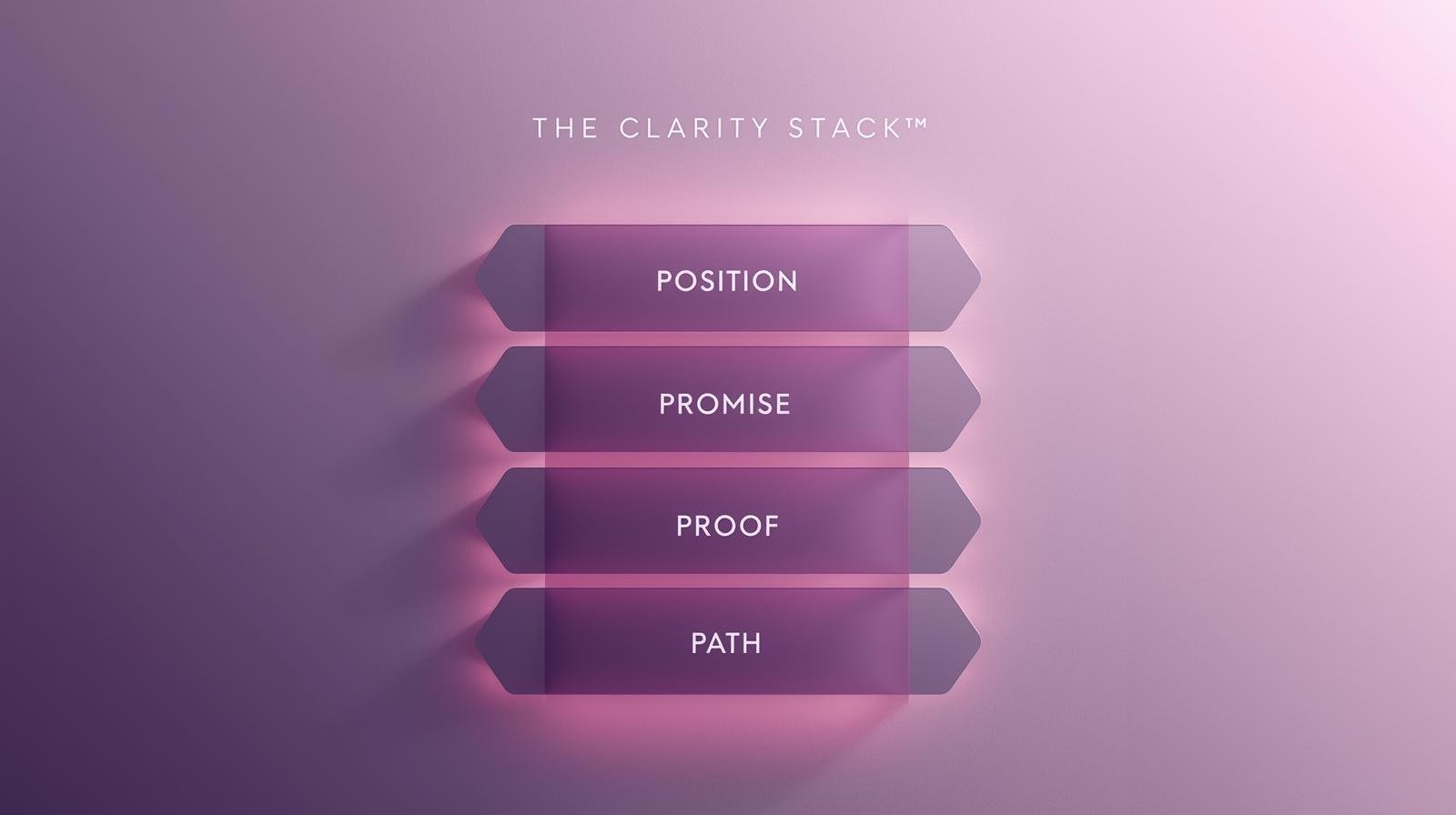 Clarity Stack is the framework I use with SaaS teams to simplify and align messaging. Here's what it looks like.
1. Position
The market you’re in, the space you own and who you’re for. If this isn’t explicit, everything else becomes vague.
2. Promise
The value you deliver. Clear, specific, differentiated. Not features, but outcomes.
3. Proof
Evidence that builds confidence: case studies, metrics, customer language. This is where deals accelerate in any sector from SaaS to tech or proof-based ESG messaging.
4. Path
The story buyers move through to understand, evaluate, and buy. This is where consistency across website → sales deck → outbound matters the most.
When these four layers are aligned, sales cycles shorten naturally.
The value-prop sanity check: your value proposition should be repeatable in one sentence. If you need a paragraph, you don’t have a value proposition, you have another paragraph.
How CMOs can fix messaging without a rebrand
Here’s the simplest way to reset your storytelling in days not months:
1. Run a messaging audit
Review your website, sales deck, outbound, product pages and demo script.
Find inconsistencies, contradictions and gaps.
Homepage audit: ignore everything below the fold and read only your hero line and first subhead. If that doesn’t explain who you’re for, what you do, and why it matters, the rest of the page won’t save you.
2. Tighten the value proposition
Anchor it around one buyer pain, not three. If your promise is diluted, the story can be really hard to tell (and almost impossible to understand).
3. Update short-form, high-impact assets first
Start with:
- Homepage hero
- Sales deck intro
- SDR outbound scripts
- Key product one-pagers
These assets shape your buyer’s first impression, and in most cases, their perception of your entire product.
4. Test the narrative live
Use sales calls, objection patterns and lost deals as feedback loops. If buyers immediately “get it” you know the message is working.
Friction finder: look at the first two objections reps hear on discovery. They’re almost always symptoms of unclear messaging, not product gaps.
5. Roll out clarity in layers
You don’t need a year-long overhaul. Both McKinsey and Gartner have shown that teams adopt new narratives more effectively when changes are incremental. Small, consistent updates land better with buyers and sales teams than a single big-bang relaunch.
The clearer the story, the faster the “yes”
SaaS growth is increasingly driven by clarity not volume.
A sharper story shortens deals. A clearer promise increases confidence. A consistent message builds trust.
And in markets where every category is crowded and every buyer is overwhelmed, clarity is no longer nice to have, it’s your competitive advantage.
Want to close your Clarity Gap?
If you’d like a quick, no-pitch look at your messaging, I offer a 20-minute clarity audit. We’ll pick one key page or asset and show you where the story drifts.
Take a look here. Get in touch here. Or click the button, below.
You might also like:
→ What happens when your product evolves but your story doesn't
→ Scaling content without scaling headcount: How to hire smarter in B2B
→ How small marketing teams can still beat the big teams



.png)