%20beam%20cutting%20across%20a%20dark%20bac.jpg)
TL;DR. Messaging drift happens when your story stops keeping pace with your product. This post defines it, shows you how to spot it and walks through ALIGN: a five-step framework for fixing it.
You’ve launched. You’ve iterated. The product’s better than ever. But scroll through your assets and you’ll see it: the dreaded messaging drift.
Three versions of the same story living across decks, emails and sales enablement. The launch video still says “revolutionary new platform,” even though you’re five features deep. The website headline doesn’t match what your SDRs are saying. And nobody can agree on the elevator pitch anymore.
Why messaging drift happens (and why it matters)
B2B buying has never been messier.
Gartner says the average buying group now includes 6–11 stakeholders, each with their own inputs, research and biases. It’s not a sales funnel anymore, it’s a loop.
Forrester calls it the buyer messaging gap: that moment when your product narrative stops matching what buyers actually care about. And most teams hit that gap within months of launch.
Meanwhile, PMMs are under pressure to “own” positioning but they’re doing it without the enablement or budget to actually roll it out across sales and marketing.
So your marketing team is running flat out just to keep up with the roadmap. Sales have just started making shit up as they go along. And your core message - the one you sweated blood over pre-launch - is being slowly rewritten in real time by whoever has a live deal this week.
It’s not bad intent, it’s drift. It’s hurting your alignment. It's sending your sales cycle waaaaay north of four months and it’s killing your deals.
Five signs your story has started to drift
Messaging drift rarely announces itself. It tends to show up in small inconsistencies that seem manageable in isolation. By the time it's obvious, it's usually been building for months.
These are the signs worth watching for.
1. Sales is telling a different story to the website
When your sales team consistently explains the company in ways that don't match the homepage, that's not a sales problem. The written story has fallen behind the live one. Sales teams are usually closer to what resonates with buyers, which makes the gap more damaging. Buyers who've already read the website notice the inconsistency, even if they don't say so.
2. Launches feel like additions, not extensions
When a new feature, product or capability lands but doesn't connect to the broader narrative, the core story isn't load-bearing anymore. Each launch feels bolted on rather than built in. Over time, the product looks more complex than it is and the story looks weaker than the product deserves.
3. Your battlecards and decks are running on old information
Deprecated features still listed. Value props that made sense two funding rounds ago. Competitive positioning that hasn't been updated since the last major product change. When sales enablement material starts lagging behind the roadmap, deals get harder to close and the gap between marketing and sales widens.
4. Nobody can agree on the elevator pitch
When leadership, marketing and sales each give a slightly different answer to "so what do you do?" the underlying story isn't settled. Buyers pick up on this faster than most teams expect, especially in multi-stakeholder deals where they're hearing multiple versions across multiple conversations.
5. The homepage describes what you do, not why people buy
Your copy is technically accurate and it explains the product. But the reason customers choose you (the real commercial argument) is nowhere to be found. Usually because whoever wrote it was thinking about the product, not the buyer. And by the time anyone notices, the page has been live for two years.
Read more about what messaging drift can cost you.
How to fix story drift: ALIGN your message
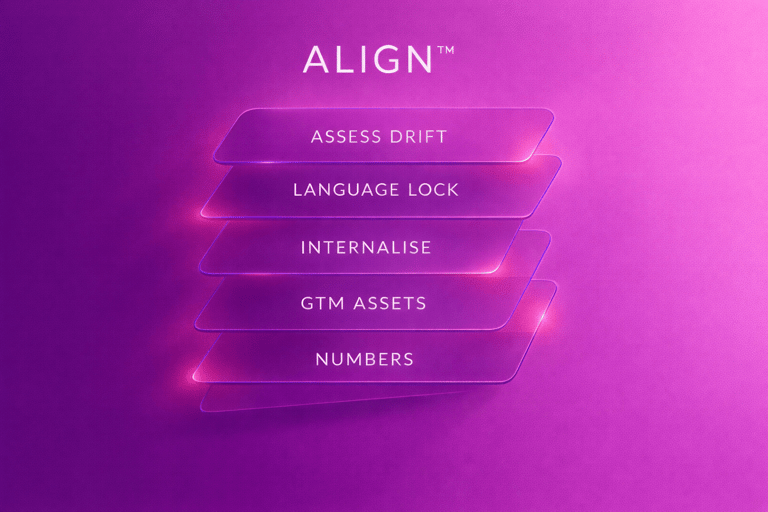 Most teams don’t need a rebrand but they do need a reset. The ALIGN Framework is a five-step process for getting your story back in front of your product (and market). Here are the five stages to ALIGN your product story.
A = Assess drift
Start by facing the mess.
Pull every deck, email, call recording, and web page into one place. Highlight where the story diverges: words, tone, even metaphors. You’ll quickly spot the chaos.
Deliverable: a drift map showing what’s out of sync.
L = Language lock
Pick one version of the truth and make it official.
Write a one-page narrative that captures your value, proof, and tone. Add a short glossary of approved terms. The difference between platform and solution shouldn’t depend on who’s talking.
Deliverable: a shared narrative + glossary.
I = Internal enablement
Don’t just share it, teach it.
Run quick sessions, build a FAQ, and arm everyone with a two-slide story they can drop into calls. The goal isn’t memorisation but consistency.
Deliverable: enablement pack (FAQ, talk tracks, slides).
G = GTM assets
Now translate that narrative into the stuff that moves markets. I'm talking your one-pagers, your nurture emails and your battlecards. Role-based if you can - your buyer and your builder audiences need different flavours of the same story.
Deliverable: aligned GTM materials.
N = Numbers
You can’t claim alignment if you can’t measure it.
Pick three metrics: asset adoption, influenced pipeline, win-rate. Track how well the new story travels through your funnel. Drift will creep back but this will help you spot it early and put it back in its box right quick.
Deliverable: success metrics + dashboard.
When to use the ALIGN framework
ALIGN works best as a reset trigger, not a maintenance tool. These are the moments that usually make it necessary.
After a significant product launch
A major release changes what the product does. It rarely changes the story at the same speed. If the launch has added capability, expanded the ICP or shifted the competitive position, the narrative needs to catch up before the next sales conversation.
After a funding round
New money brings new expectations, new hires and often a new strategic direction. It also brings new stakeholders who will form their own version of the story if a clear one isn't already in place. Getting alignment early saves a lot of rewriting later.
Before a campaign or GTM push
Running demand generation on top of drifted messaging amplifies the wrong story faster. ALIGN before you spend, not after you wonder why it didn't land.
When sales and marketing are visibly out of sync
If the two teams are using different language, different proof points or different framings for the same product, the story has already fragmented. ALIGN gives both sides a shared foundation to work from rather than a memo telling them to get on the same page.
After a repositioning or ICP shift
When the target customer changes, almost everything downstream needs updating. The homepage, the deck, the nurture sequence, the case studies. ALIGN provides a structured way to work through that systematically rather than patching assets one by one as the gaps surface.
Why this works
Because despite what creative folks like me sometimes try to tell you, story alignment isn’t really about creativity. It’s about coherence.
Coherence turns every sales call, ad and asset into a reinforcing loop instead of a guessing game and it also makes your people better storytellers. And when everyone speaks from the same script, the message gets stronger. Buyers start hearing the same phrasing from your website to your AE. That repetition builds trust (and trust closes deals faster than any discount).
Story drift happens. Diligence fixes it
The truth is, drift’s not the enemy. Neglect is your enemy.
Every story evolves over time, but it’s the teams who notice it, name it and nudge it back on track are the ones who stay believable.
Audit often. Align fast. Keep the message sharp. That’s how you stop a great story from turning into background noise.
Frequently asked questions about messaging drift
What is messaging drift?
Messaging drift is what happens when a company's story stops keeping pace with its product. As the product evolves, the market shifts and the team grows, the narrative holding everything together starts to lag. The homepage describes an older version of the business. The sales deck says something different. The exec team gives a different answer again. None of it is wrong exactly, but the accumulated inconsistency starts costing you credibility at the moments it matters most.
How do you know if your messaging has drifted?
The clearest signal is when sales consistently explains the company differently to the website. Other signs include launches that feel disconnected from the core narrative, battlecards running on outdated information, and internal debates about how to describe the product that never quite get resolved. If nobody can agree on the elevator pitch, the story has drifted.
What causes messaging drift in B2B companies?
Usually a combination of speed and competing priorities. The product roadmap moves fast. Campaigns have deadlines. Revenue targets don't wait. The homepage feels like finished work so it gets deprioritised. Meanwhile the story keeps being rewritten in real time by whoever has a live deal this week. Drift is the natural result of a business growing faster than its narrative.
How long does it take to fix messaging drift?
It depends on how far the story has slipped and how aligned the senior team already is on what the company does and why it wins. A focused ALIGN process typically takes two to four weeks from audit to updated assets. The bigger variable is internal alignment, not the writing.
Who should own messaging alignment in a B2B company?
Product marketing is the natural home for it, but the work only sticks if sales, marketing and leadership are all involved in the reset. Messaging that gets handed down from one team tends to get ignored by the others. The teams who maintain alignment longest are the ones who build it together.
What is the ALIGN framework?
ALIGN is a five-step framework for getting a B2B company's story back in front of its product. It covers drift assessment, language lock, internal enablement, GTM asset alignment and measurement. It's designed as a practical reset, not a rebrand, and can be applied after a product launch, a funding round, a repositioning or any point where the story has visibly fragmented across teams.
Is messaging drift the same as a positioning problem?
Related but not identical. Positioning defines how a company wants to be understood in the market. Messaging drift is what happens when that positioning stops being consistently communicated. You can have solid positioning and still have significant drift if the narrative isn't being maintained across assets and teams. In practice the two problems often travel together, but drift can usually be fixed without starting the positioning from scratch.
When should a company use ALIGN versus a full rebrand?
If the core positioning is still sound but the execution has fragmented, ALIGN is the right tool. A rebrand makes sense when the positioning itself is wrong, the market has fundamentally shifted or the company has outgrown its original story entirely. Most teams that think they need a rebrand actually need an alignment reset first.
Worried your messaging is on the drift?
If you’d like a fast, focused sanity check, book a 20-minute alignment review. I’ll review one asset or sales deck and call out any messaging gaps or inconsistencies that could be slowing you down.
Last updated Monday 1 July, 2026.
You might also like:
→ Scaling content without scaling headcount: How to hire smarter in B2B
→ How to write ESG content that wins deals (and keeps investors happy)
→ How small marketing teams can beat the big guys
→ Three messaging pivots every green start-up should steal