
TL;DR
Sales enablement content goes unused when it’s built around marketing’s message instead of buyers’ conversations, so sales improvise their own version and the story ends up discarded in a ditch somewhere.
Photo by Photos of Korea on Unsplash
***
B2B sales enablement content is content designed to help sales teams move deals forward. It includes assets like case studies, battlecards, pitch decks, one-pagers and stakeholder-specific content that supports buyers throughout the decision-making process.
The problem is that a surprising amount of it never gets used.
If you've ever spent weeks creating a case study or sales deck only to discover sales has created its own version, you've already seen the issue first-hand. The usual explanation is that sales and marketing aren't aligned and there's certainly some truth in that. But after working with enough B2B marketing teams, I've become convinced that the bigger problem is often the content itself.
Not because it's bad. But because it was built around the message the business wanted to communicate rather than the conversations buyers were really having.
What is B2B sales enablement content?
Sales enablement content sits much closer to revenue than most marketing content.
Where a blog post might be designed to generate awareness and a landing page might be designed to generate interest, sales enablement content exists to help buyers make decisions. It helps sales teams answer questions, overcome objections and build confidence during active opportunities.
Typical examples include:
- Case studies
- Battlecards
- Product one-pagers
- Executive summaries
- Competitor comparisons
- Pitch decks
- ROI and business case content
In theory, these assets should make life easier for everyone involved. Marketing creates useful content, sales uses it in conversations and buyers get the information they need to move forward.
In practice, most organisations have at least one shared drive full of perfectly respectable assets that nobody has opened in months.
Why sales enablement content often goes unused
One of the biggest misconceptions in B2B marketing is that sales teams ignore content because they're stubborn.
Sometimes that's true. More often, sales teams are simply adapting to reality.
A salesperson working on a live deal isn't thinking about campaign messaging or brand consistency. They're thinking about the procurement team that's asking difficult questions, the CFO who suddenly wants ROI figures or the champion who's struggling to get internal buy-in.
If a piece of content helps them navigate those conversations, they'll use it. If it doesn't, they'll create something else.
That's why you often see regional teams building their own decks, sales leaders rewriting approved messaging and different prospects hearing completely different explanations of the same product. What looks like a process problem is almost always a sign that the story broke at the handoff between marketing and sales.
I've seen this happen plenty of times in growing SaaS companies. Marketing's producing good content, sales isn't using it and everyone assumes they've got an adoption problem. More often, they've got a narrative problem. The story that works on the website isn't surviving first contact with a real buyer.
The strongest sales enablement strategies recognise this. They focus less on producing assets and more on making those assets genuinely useful in the moments where deals move forward or stall.
Why case studies are the biggest enablement offender
Case studies are probably the biggest offender.
Most are written as success stories about the vendor. They explain the challenge, describe the solution and finish with a carefully approved quote that nobody involved would ever actually say out loud (and doesn’t even hit the main thing the product solves for).
Meanwhile the buyer is trying to answer a completely different set of questions.
- Was this customer actually like us?
- Did they face the same challenge?
- How difficult was implementation?
- What happened six months later?
- Could I use this example to justify a purchase internally?
The best case studies answer those questions quickly. The weakest spend hundreds of words explaining how wonderful the provider was.
That's why salespeople are constantly pulling individual anecdotes and examples out of larger case studies and using them in conversations instead. They're instinctively trying to make the story relevant to the buyer sitting in front of them.
Good case studies don't celebrate the vendor, they help the next buyer recognise themselves. Here's how to write ones that actually make a deal move faster.
How to align sales and marketing messaging
For years we've been told that sales and marketing need to be aligned.
Fair enough.
But I think a lot of organisations interpret that as meaning everyone should say exactly the same thing in exactly the same way. That's rarely how good sales teams operate.
The best salespeople adapt. They change their language depending on who they're speaking to. They emphasise different outcomes when talking to a CFO than they would when talking to an operational stakeholder. They know which objections matter and which don't.
That's where many organisations struggle. Marketing creates messaging, sales develops narratives that work in real conversations. Over time those two things drift apart and every team ends up telling a slightly different version of the truth. This is called messaging drift (and it's a right pain in the arse).
The strongest sales enablement content sits between the two without drifting. It gives sales enough flexibility to adapt while keeping everyone anchored to the same underlying narrative about what the company does, who it's for and why it matters.
Without that foundation, every deal becomes an improvisation.
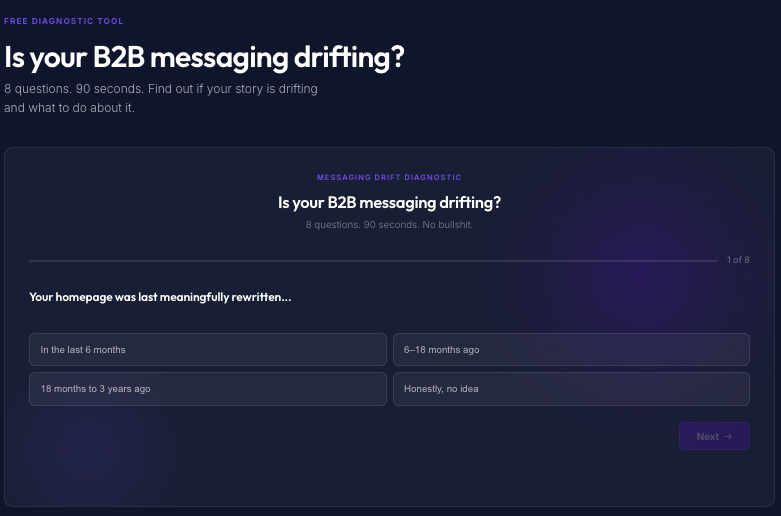 Is your messaging on the drift? Try this free diagnostic tool to see what it means (and what you can do to fix it).
How to create sales enablement content sales teams will use
Before creating your next case study, battlecard or one-pager, it's worth asking a few simple questions.
- What conversation is this designed to support?
- Which stakeholder is it for?
- What question does it answer?
- What objection does it remove?
- How will a salesperson actually use it?
They're not especially glamorous questions, but they're usually more useful than debating formats, templates or design systems. Because the sales enablement content that gets used isn't necessarily the most polished, but it is the most useful.
Sometimes the right answer isn’t another deck. A short product video or lightweight walkthrough may be easier for reps to share and buyers to digest.
In any event, the assets that survive will be the ones that help sales teams navigate real conversations with real buyers. They answer difficult questions, provide credible proof and make decisions easier.
Everything else tends to end up where most unused sales enablement content ends up: somewhere in a shared drive, gathering digital dust.
That's exactly the gap I see most often when working with growing B2B companies. Marketing's producing the content, sales isn't using it. And the disconnect is usually costing more than anyone realises.
Frequently Asked Questions
What is B2B sales enablement content?
B2B sales enablement content includes assets designed to help sales teams move opportunities forward, such as case studies, battlecards, one-pagers, pitch decks and competitor comparisons.
Why don't sales teams use marketing content?
Sales teams are more likely to ignore content that doesn't help them answer buyer questions or handle objections. If content isn't useful during real sales conversations, they'll often create their own alternatives.
What types of sales enablement content work best?
The most effective sales enablement content is built around buyer questions, stakeholder concerns and common objections. Case studies, battlecards and stakeholder-specific collateral are often among the most valuable assets.
What is the difference between marketing content and sales enablement content?
Marketing content is typically designed to generate awareness and demand. Sales enablement content supports active opportunities and helps buyers make decisions during the sales process.
How do you measure sales enablement content effectiveness?
Usage by sales teams is a strong starting point. Beyond that, organisations often look at influence on pipeline progression, deal velocity, stakeholder engagement and qualitative feedback from sales teams.



.png)